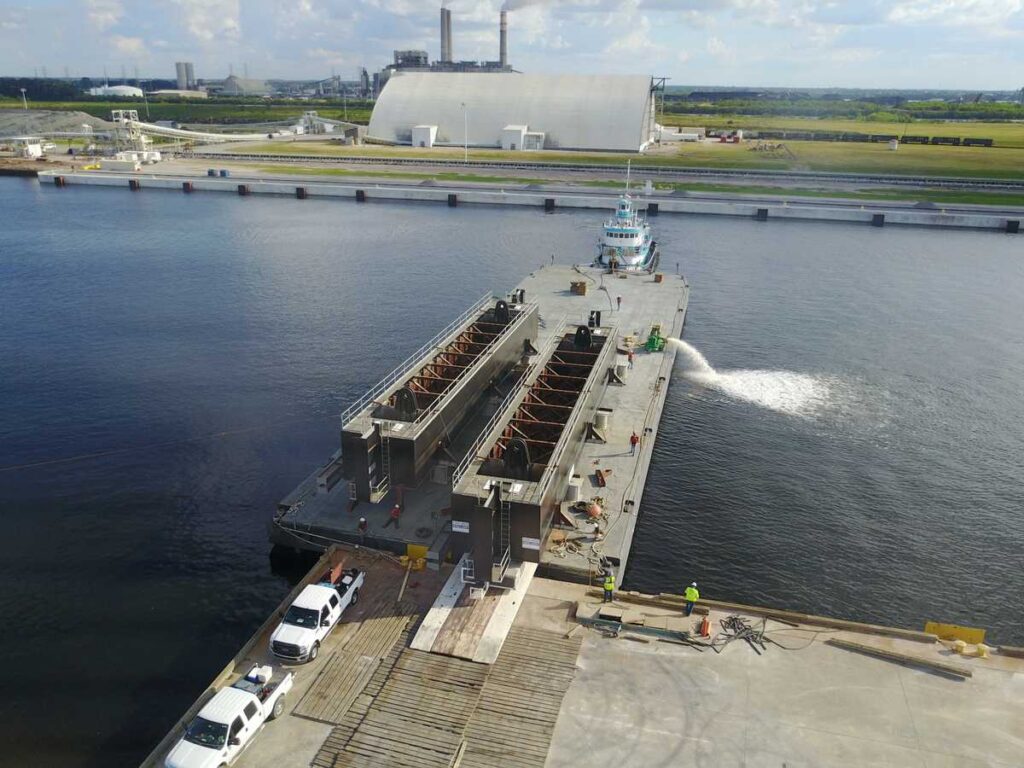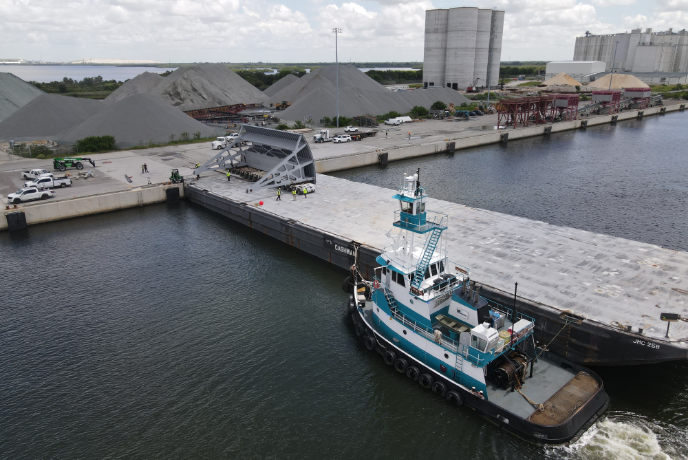
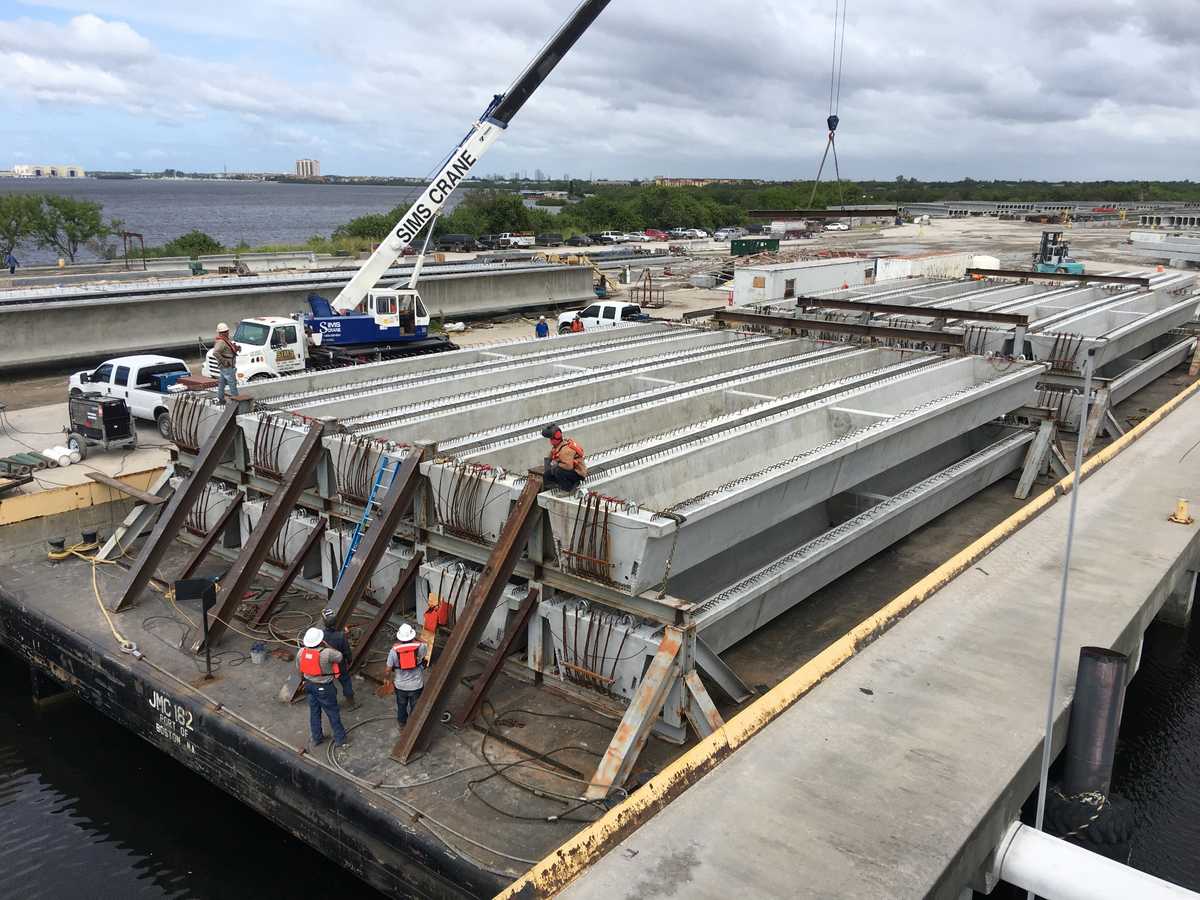
Before oversized or heavy cargo can be transported by barge, it must make the critical transition between land and water. That transfer may involve rolling the cargo across a ramp, lifting it with a heavy-lift crane or floating it into position over a prepared barge. Each approach solves a different set of logistical challenges, and choosing the right one can affect the engineering, equipment, schedule and cost of the entire movement.
For companies seeking an experienced barge service, loadout planning should begin with the cargo itself and continue through every condition at the origin and destination. Florida Barge Corp coordinates turnkey marine transportation for oversized, heavy and complex project cargo, including roll-on/roll-off, lift-on/lift-off and float-on/float-off operations.
Why the Loadout Method Matters
The loadout is one of the most technically demanding stages of a project cargo movement. During this operation, an unusually large or heavy structure is transferred from one support system to another while the barge is responding to weight, water, tide and environmental conditions.
The selected method determines many of the project’s requirements, including:
- Marine and structural engineering
- Barge size, configuration and deck capacity
- Ballasting and stability procedures
- Crane, transporter or flotation requirements
- Temporary ramps, supports and cargo securement
- Site access and staging space
- Water depth, tidal limitations and operating windows
- Coordination among crews, terminals and equipment operators
That is why loadout selection should be treated as part of the complete transportation plan rather than as an isolated decision.
Roll-On/Roll-Off Loadout
During a roll-on/roll-off operation, often shortened to RoRo, cargo is moved between shore and barge on wheeled transportation equipment. Self-propelled modular transporters, commonly called SPMTs, are frequently used for extremely heavy or oversized loads because their axle lines can distribute weight and provide precise control.
A temporary or permanent ramp connects the loading area to the barge. The transporter carries the cargo across that interface and moves it into its engineered position on deck. The same basic process is reversed at the destination.
When Roll-On/Roll-Off May Be Appropriate
Roll-on/roll-off can be a practical choice when the cargo can be supported on transporters and both facilities provide sufficient access. It is often considered for bridge components, industrial modules, transformers, large fabricated structures and other cargo already moving through the site on modular transport equipment.
This method can reduce or eliminate the need for a major crane lift at the waterfront. It may also allow the cargo to remain on the same transportation platform as it moves from the fabrication area or staging location onto the barge.
Key Roll-On/Roll-Off Considerations
RoRo planning requires careful evaluation of the complete travel path. Engineers and operators may need to address:
- Ground-bearing capacity along the transporter route
- Ramp strength, width, slope and connection details
- Dock elevation and available waterfront access
- Tidal range and changes in barge deck elevation
- Transporter capacity, axle loading and maneuvering space
- Barge deck capacity and cargo support locations
- Ballasting as the load crosses from shore to barge
As the cargo moves across the ramp, its weight shifts from land to the floating barge. This can change the barge’s draft, trim and deck elevation throughout the operation. A planned ballasting sequence may be required to maintain a controlled ramp angle and keep the barge properly positioned.
Lift-On/Lift-Off Loadout
During a lift-on/lift-off operation, or LoLo, a crane transfers the cargo between land, a transport vehicle and the barge. Depending on the weight, dimensions, lifting radius and site conditions, the operation may use a shore-based crane, crane barge or another heavy-lift arrangement selected for the project.
Lift-on/lift-off is often considered when rolling access is unavailable, when the cargo can be safely handled through engineered lifting points or when a crane provides the most practical way to reach the required position on deck.
When Lift-On/Lift-Off May Be Appropriate
LoLo can be effective for turbines, transformers, machinery, fabricated components and other cargo designed or prepared for lifting. It may be particularly useful at terminals with established crane access or in locations where shoreline geometry makes a roll-on ramp impractical.
A crane can place cargo directly onto engineered supports on the barge, but the feasibility of the lift depends on more than the cargo’s total weight. Crane capacity changes with lifting radius, boom configuration and operating conditions, making accurate lift geometry essential.
Key Lift-On/Lift-Off Considerations
Planning a heavy lift generally requires evaluation of:
- Verified cargo weight and center of gravity
- Engineered lifting points and structural capacity
- Crane capacity at the required lifting radius
- Rigging design, sling angles and lifting clearances
- Crane setup area and ground-bearing capacity
- Barge stability during pickup and placement
- Wind, visibility, tide and allowable operating conditions
- Final cargo orientation and access for securement
Float-On/Float-Off Loadout
Float-on/float-off operations are designed for dredges, workboats, floating structures and other equipment that can be moved while afloat. Instead of rolling the cargo aboard or lifting it with a crane, the barge is ballasted to create the required loading condition. The floating equipment is maneuvered over its planned deck position, and the barge is then deballasted in a controlled sequence until the cargo is supported for transport.
The process is reversed at the destination. The barge is ballasted according to the engineered plan until the transported equipment can float free and be moved away safely.
When Float-On/Float-Off May Be Appropriate
Float-on/float-off can be a practical solution for equipment that is already buoyant and would be difficult or inefficient to lift. Dredges and other floating assets may have dimensions, structural characteristics or lifting limitations that make flotation the preferred transfer method.
This method can avoid a major crane lift and may provide an effective way to transport floating equipment over longer distances or through waterways where operating under its own power would be impractical.
Key Float-On/Float-Off Considerations
A float-on operation may require detailed analysis of:
- Cargo draft, buoyancy and flotation characteristics
- Available water depth and under-keel clearance
- Barge ballasting and deballasting capacity
- Stability throughout every stage of the operation
- Tide, current, wind and wave conditions
- Tug or support vessel requirements
- Positioning, alignment and temporary restraint
- Deck supports and final cargo securement
How the Three Loadout Methods Compare
No single loadout method is automatically better than the others. The best choice is the method that fits the cargo, facilities, route and available equipment while providing a controlled operation from beginning to end.
Choose Roll-On/Roll-Off When:
- The cargo can be carried on modular transport equipment
- A suitable ramp and waterfront approach can be established
- The origin and destination provide adequate access and staging space
- Transporter and ballasting operations can be coordinated safely
Choose Lift-On/Lift-Off When:
- The cargo has suitable engineered lifting points
- A properly sized crane can operate at the required radius
- Rolling access is limited or unavailable
- The lift provides the most practical path to the cargo’s deck position
Choose Float-On/Float-Off When:
- The cargo is a dredge, vessel or other floating asset
- Water depth and site conditions support the operation
- The barge can achieve the required loading condition through ballasting
- Floating the equipment is more practical than rolling or lifting it
Florida Barge Corp evaluates these factors as part of its complete project planning, specialized cargo loadout and barge transportation services. Photographs of heavy-lift, oversized cargo and marine transportation work can also be viewed in the company’s project gallery.
Origin and Destination Conditions Can Change the Answer
The preferred method must work at both ends of the transportation route. A project may have excellent roll-on access at the origin but no suitable ramp area at the destination. A lift may be easy to arrange at a major terminal but difficult at a remote shoreline. A floating asset may be simple to load in deep water but face draft limitations at delivery.
Early site evaluation helps identify water depth, dock strength, staging limitations, crane access, transporter routes, tidal constraints and other factors before they affect the schedule. It also allows the transportation provider to coordinate the correct barge, towing vessel, equipment and engineering resources.
Engineering and Coordination Connect Every Phase
Regardless of the selected method, a successful loadout depends on engineering and precise coordination. Cargo information must be verified, the barge must provide the necessary capacity and stability, and terminal personnel, equipment operators, marine crews, engineers and riggers must work from one defined sequence. Weather limits, communication procedures and contingency plans should be established before the operation begins.
Additional information about marine transportation planning, equipment selection and heavy cargo logistics is available through the Florida Barge Corp blog.
Barge Service for Specialized Cargo Loadout
Florida Barge Corp provides turnkey marine transportation for oversized and specialized project cargo. Its capabilities include project planning and engineering, roll-on/roll-off using SPMTs, lift-on/lift-off using heavy-lift cranes, float-on/float-off for dredges and other floating equipment, barge transportation and final delivery.
The company offers ABS barges ranging from 150 feet by 50 feet to 400 feet by 100 feet, supported by U.S.-flag towing vessels with up to 5,000 horsepower. Service areas include the U.S. East Coast, Gulf of Mexico, Caribbean, Central America and South America.
If you are evaluating a loadout method, begin with the cargo dimensions, weight, center of gravity, origin, destination, schedule and known site conditions. Contact Florida Barge Corp to discuss the movement and determine whether roll-on, lift-on or float-on provides the right solution for your project.
Frequently Asked Questions
What is the difference between roll-on and lift-on barge loading?
Roll-on loading uses wheeled equipment such as SPMTs to carry cargo across a ramp and onto the barge. Lift-on loading uses a crane and engineered rigging to place the cargo onto supports on the barge deck.
What types of cargo are suitable for float-on/float-off transportation?
Float-on/float-off is generally used for buoyant equipment such as dredges, workboats and other floating structures that can be positioned over a prepared barge during a controlled ballasting operation.
Can the same loadout method always be used at both ends of the route?
Not necessarily. The origin and destination may have different water depths, dock configurations, crane access, transporter routes or staging limitations. Each site must be evaluated as part of the complete transportation plan.
When should a barge service become involved in the project?
As early as practical. Early involvement allows the transportation team to review cargo information, compare loadout options, evaluate site and route constraints, identify equipment requirements and coordinate the movement before other project decisions limit the available solutions.