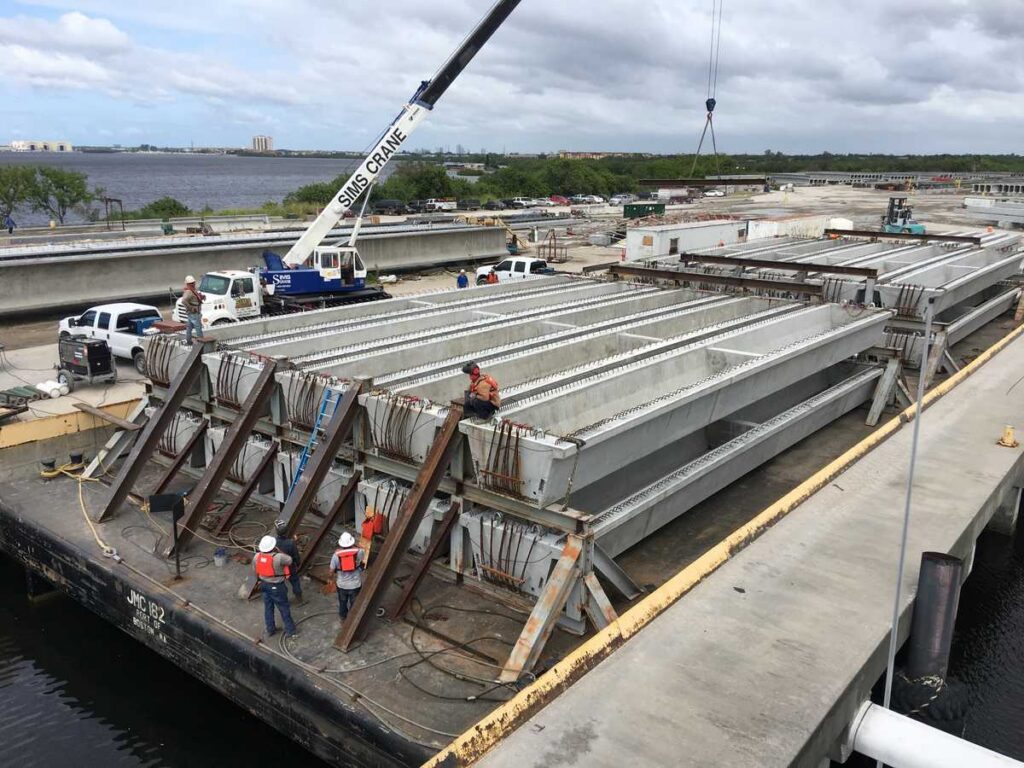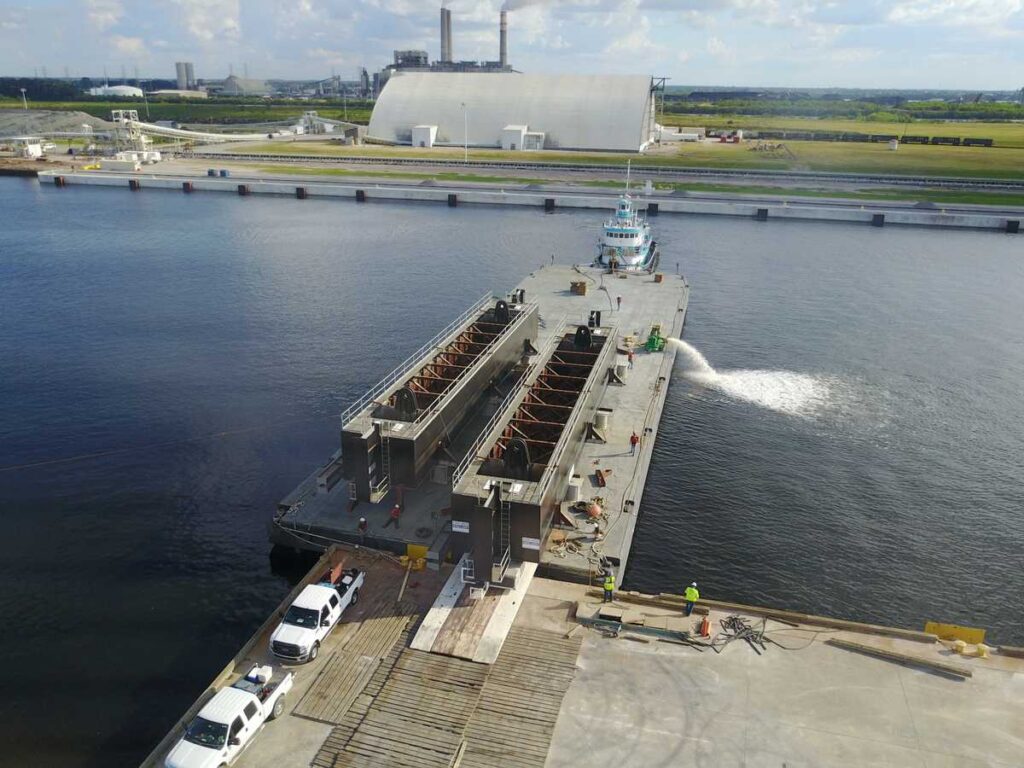
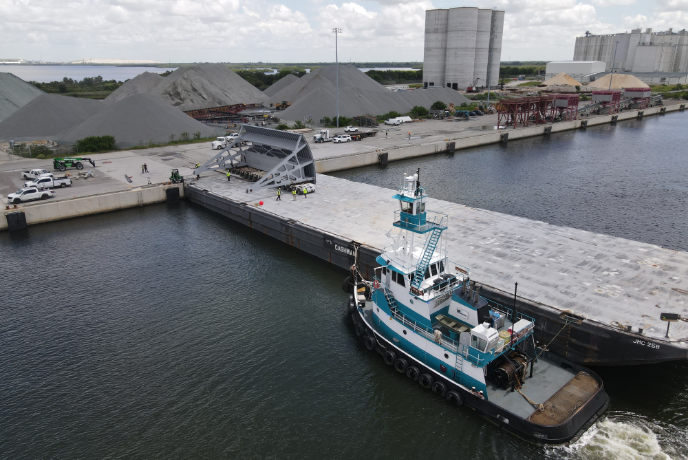
For companies seeking a reliable barge service, the best solution starts with a complete understanding of the cargo and the conditions it will encounter from origin to destination. Florida Barge Corp coordinates turnkey marine transportation for oversized, heavy and complex project cargo throughout the U.S. East Coast, Gulf of Mexico, Caribbean, Central America and South America.
Start With the Cargo
The cargo itself determines the basic requirements of the transportation system. Before a barge or tug can be selected, the project team must establish accurate information about the cargo, including:
- Overall length, width and height
- Total weight and center of gravity
- Concentrated loads and support points
- Structural strength and handling limitations
- Required orientation on the barge
- Lifting, rolling or flotation requirements
- Sensitivity to motion, weather or saltwater exposure
A transformer, turbine, bridge component, industrial module or piece of dredging equipment may each present a completely different load profile. Even cargoes with similar total weights can require different barges because of how that weight is distributed across the deck.
Accurate cargo information allows marine engineers and transportation specialists to evaluate deck loading, stability, freeboard, securement and operational clearances before equipment is committed. Early planning also reduces the risk of discovering a dimensional or structural constraint after the project is already underway.
Choose a Barge With the Right Dimensions and Deck Capacity
Barge selection is not simply a matter of finding a deck long and wide enough to hold the cargo. The barge must support the load safely while providing adequate working space for transporters, cranes, rigging, sea fastening and crew operations.
Important factors include deck strength, overall dimensions, available deck area, hull configuration, draft, freeboard and the ability to distribute concentrated loads. The cargo may also need to be positioned carefully to maintain proper trim and stability during loading, transportation and unloading.
Florida Barge Corp offers ABS barges ranging from 150 feet by 50 feet to 400 feet by 100 feet. That range allows the project team to match the barge to the cargo instead of forcing a complex load onto unsuitable equipment. The company has handled individual cargoes exceeding 300 feet and three million pounds, demonstrating the scale of planning and equipment required for major project cargo movements.
Account for Weight Distribution, Stability and Ballasting
A heavy cargo movement changes the way a barge sits and responds in the water. Engineers must evaluate where the cargo weight will be applied, how the barge will react during loadout and whether ballasting will be required to control deck elevation, list and trim.
This is especially important during roll-on/roll-off operations. As a self-propelled modular transporter moves from shore onto the barge, the load shifts continuously. Ballast may need to be adjusted in a carefully planned sequence to keep the ramp angle and barge position within acceptable limits.
Stability calculations must also account for the cargo’s center of gravity, projected wind area, water conditions and the anticipated route. Tall industrial modules or unusually shaped structures may create different stability and wind-loading concerns than lower-profile cargo of the same weight. These calculations should be completed by qualified professionals as part of the project’s engineering process.
Match the Barge to the Loadout Method
The correct barge also depends on how the cargo will move between land and water. Florida Barge Corp coordinates three primary loadout methods as part of its marine transportation services.
Roll-On/Roll-Off
Roll-on/roll-off operations use self-propelled modular transporters or similar equipment to move cargo directly onto or off the barge. The project team must evaluate deck elevation, ramp geometry, tidal variation, shoreline access, ground-bearing capacity and the barge’s response as the load crosses the ramp.
Lift-On/Lift-Off
Lift-on/lift-off operations use heavy-lift cranes to transfer cargo between the dock, transport vehicle and barge. Barge selection must account for crane access, rigging clearances, lifting radius, cargo placement and the structural requirements at each lifting point.
Float-On/Float-Off
Float-on/float-off operations may be used for dredges, workboats and other floating equipment. Water depth, draft, submergence, ballasting capacity and site conditions become central considerations when selecting the barge and planning the operation.
Examples of these operations and the types of cargo involved can be seen in the Florida Barge Corp project gallery.
Evaluate the Entire Transportation Route
The right barge at the loading site must also be the right barge for the complete route. A barge service should evaluate the origin, destination and every significant constraint between them.
Route planning may include:
- Channel width and controlling water depth
- Bridge clearances and overhead restrictions
- Locks, terminals and restricted waterways
- Tides, currents and seasonal water levels
- Port requirements and operating windows
- Weather exposure and safe-harbor options
- Dock, bulkhead and shoreline conditions
- Space for maneuvering at the origin and destination
A larger barge may provide more deck space but introduce draft, access or maneuverability limitations. Conversely, a smaller barge may navigate the route more easily but lack the deck capacity, stability or working area required for the cargo. The final selection must balance all of these conditions.
Select the Tug for the Barge, Route and Conditions
Horsepower is an important part of tug selection, but it is not the only consideration. The towing vessel must be appropriate for the size and configuration of the barge, the displacement of the loaded unit, the distance and route, expected currents, weather exposure, maneuvering requirements and applicable regulations.
Florida Barge Corp works with U.S.-flag towing vessels rated up to 5,000 horsepower. The appropriate towing resource is selected according to the actual demands of the movement. A protected inland route may call for a different vessel than an exposed coastal transit or a project requiring precise maneuvering near a terminal.
The project plan may also need to address towing configuration, assist tugs, crew requirements, fuel range, communications and contingency planning. Selecting a properly matched tug helps maintain control of the tow, support the schedule and reduce unnecessary operational risk.
Consider the Origin and Destination Facilities
Even when the barge and tug are suitable for the route, the project can be limited by conditions at the loading or unloading site. Available water depth, tidal range, dock strength, crane access, staging space and shoreline geometry all influence the equipment and operational plan.
Some projects begin or end at facilities that were not designed for major project cargo. In these cases, the transportation team may need to coordinate temporary ramps, heavy-lift cranes, modular transporters, ballasting procedures or alternative access points. Site evaluations should occur early enough to identify these needs without affecting the project schedule.
Plan Cargo Securement and Operational Sequencing
The barge, tug and cargo must function as one transportation system. Cargo securement is developed around the anticipated forces of the transit and the structural characteristics of both the cargo and barge. The plan may include grillage, cribbing, supports, tie-downs, welded sea fastenings or other engineered measures.
Operational sequencing is equally important. The order of ballasting, loading, positioning, securement, departure, arrival and unloading must be coordinated among engineers, terminal personnel, equipment operators, towing crews and other project partners. One experienced point of contact can help keep these interdependent activities aligned.
Why Early Planning Matters
Bringing a marine transportation provider into the project early creates more opportunities to solve constraints efficiently. Barge availability, tug scheduling, engineering, permits, terminal access and specialized equipment can all affect the timeline. Early coordination allows the team to compare options before decisions elsewhere in the project limit what is possible.
It also helps establish a more accurate scope and budget. A complete plan accounts for the full movement, rather than treating the barge, tug, loadout and delivery as disconnected services. Additional information about heavy cargo planning and marine transportation is available through the Florida Barge Corp blog.
Barge Service for Heavy and Oversized Cargo
Florida Barge Corp provides project planning and engineering, specialized cargo loadout, barge transportation and delivery from its base. Its team coordinates the critical details of each movement from inception through final delivery, with capabilities supporting bridge components, transformers, turbines, industrial modules, dredging equipment, floating structures and other oversized cargo.
If you are planning a heavy cargo movement, begin with the cargo dimensions, weight, origin, destination, preferred schedule and known site conditions. Contact Florida Barge Corp to discuss the project and determine the right barge, towing resources and transportation plan for the job.
Frequently Asked Questions
What information is needed to select a barge for heavy cargo?
The initial evaluation typically requires the cargo’s dimensions, weight, center of gravity, support points, origin, destination, preferred schedule and proposed loading method. Information about access, water depth, lifting requirements and other site conditions is also valuable.
Is tug horsepower the main factor in towing vessel selection?
No. Horsepower matters, but the towing vessel must also be matched to the loaded barge, route, distance, weather exposure, currents, maneuvering requirements and regulatory conditions.
What types of heavy cargo can be transported by barge?
Common project cargo includes bridge components, transformers, turbines, industrial modules, prestressed concrete components, dredging equipment, floating structures and other loads that are too large or heavy for conventional road transportation.
Why use a barge service for project cargo?
We offer access to major waterways and coastal transportation routes. A provider can coordinate marine transportation serving Florida, the U.S. East Coast, the Gulf of Mexico, the Caribbean and destinations throughout Central and South America.